
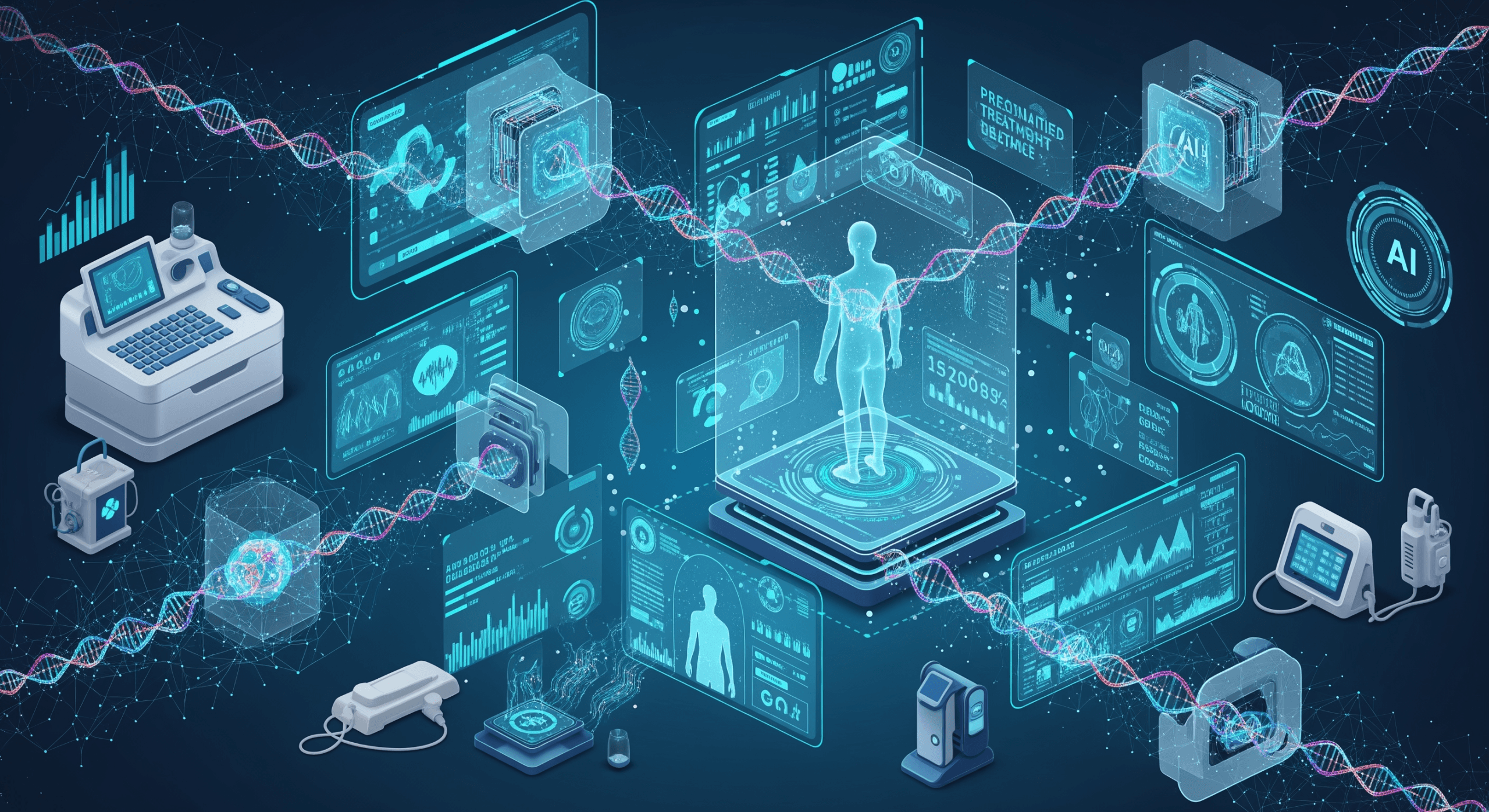
AI in Personalized Medicine: From Data to Individual Treatment
Audio Overview
AI in Personalized Medicine: From Data to Individual Treatment
🎧 Audio Overview
summary, or read the transcript below:
View Audio Transcript
For decades, medicine operated on a one-size-fits-all model. Same diagnosis, same treatment. But we’re moving into an era where artificial intelligence enables truly personalized care tailored to each individual’s biology.
AI’s power comes from processing complexity that exceeds human capacity. A single patient generates enormous data: genetic variants, protein levels, decades of medical history, lifestyle factors. AI finds patterns in this multidimensional data that predict disease risk and treatment response.
The applications are already here. In oncology, AI analyzes tumor genomics to match mutations with targeted therapies. In cardiology, algorithms assess hundreds of variables to predict who’s at highest risk for heart attacks. Pharmacogenomics at scale—AI tells us which medications will work best based on your genetic profile.
Diagnostic accuracy improves dramatically. AI detects lung nodules, early cancers, brain bleeds, findings that human readers might miss. Not replacing physicians—augmenting clinical judgment with data-driven insights.
In my practice integrating AI tools, I see immediate benefits: better diagnostic accuracy, more evidence-based treatment selection. But AI doesn’t eliminate clinical judgment—it enhances it.
Challenges remain: data quality, privacy, interpretability. But the trajectory is clear. We’re moving from treating patients as averages to recognizing each person’s biological uniqueness. That’s what personalized medicine has always promised. AI makes it practical.

For decades, medicine operated on a one-size-fits-all model. Two patients with the same diagnosis typically received the same treatment, despite potentially having different genetics, lifestyles, and disease mechanisms. Precision medicine challenged that model by recognizing biological individuality. Now, artificial intelligence is making truly personalized care not just possible, but practical.
AI’s ability to process vast amounts of complex data—genomic sequences, medical imaging, electronic health records, real-time biosensor data—and identify patterns humans can’t see is transforming how we diagnose disease, predict outcomes, and tailor treatments to individual patients.
This isn’t futuristic speculation. AI-driven personalized medicine is happening now in oncology, cardiology, neurology, and other specialties. Understanding how it works and what it means for patient care requires looking at specific applications rather than abstract promises.
What Makes AI Powerful for Personalized Medicine?
Traditional statistical methods struggle with the complexity of human biology. A single patient generates enormous amounts of data: thousands of genetic variants, hundreds of protein levels, decades of medical history, environmental exposures, lifestyle factors, and more. Finding meaningful patterns in this multidimensional data exceeds human cognitive capacity.
AI excels at exactly this challenge. Machine learning algorithms can identify subtle relationships between variables that predict disease risk or treatment response. They improve with more data, learning patterns that even experienced clinicians might miss.
Deep learning—a subset of AI using neural networks—can analyze medical images with superhuman accuracy. Natural language processing extracts insights from unstructured clinical notes. Algorithms integrate genomic data with clinical outcomes to predict which drugs will work for which patients.
The key is that AI doesn’t replace clinical judgment—it augments it. The technology processes data at scale and speed impossible for humans, then presents findings that clinicians interpret within the context of individual patient circumstances.
AI in Cancer Treatment
Oncology has been an early adopter of AI-driven personalization, and for good reason. Cancer is fundamentally a disease of genomic alterations, and tumors from different patients—even with the same diagnosis—can have dramatically different molecular profiles.
AI algorithms analyze tumor genomic sequencing to identify specific mutations, then match those mutations to targeted therapies. This goes beyond simple gene-drug matching. Machine learning models consider combinations of genetic alterations, tumor microenvironment factors, and patient characteristics to predict which treatments are most likely to work.
In radiation oncology, AI optimizes treatment planning by analyzing CT and MRI scans to precisely delineate tumors and critical structures. The algorithms generate treatment plans that maximize radiation dose to cancer while minimizing exposure to healthy tissue—a personalization impossible to achieve manually at the same level of precision.
Early results show improved outcomes. Patients receiving AI-guided therapy selection based on tumor genomics show better response rates than those receiving standard protocols in several cancer types.
Predicting Cardiovascular Risk
Cardiovascular disease remains the leading cause of death globally, and AI is transforming how we identify at-risk individuals and personalize prevention strategies.
Traditional risk calculators use a handful of variables—age, cholesterol, blood pressure, smoking status—to estimate heart attack or stroke risk. AI models incorporate hundreds of variables: genetic variants, imaging findings, inflammatory markers, lifestyle data from wearables, even social determinants of health.
Machine learning analysis of cardiac MRI and CT angiography can detect early atherosclerosis or subtle function abnormalities that human readers might miss. These algorithms predict which plaques are likely to rupture and cause heart attacks—a distinction that’s crucial for targeting intensive prevention to the patients who need it most.
AI also personalizes treatment. Algorithms predict which blood pressure medications will work best for individual patients based on their genetic profile, comorbidities, and other factors. This reduces the trial-and-error approach that often frustrates both patients and physicians.
Pharmacogenomics at Scale
Your genetic makeup significantly influences how you metabolize medications. Variants in genes encoding drug-metabolizing enzymes can make you a rapid metabolizer, normal metabolizer, or poor metabolizer of specific drugs. This affects both efficacy and side effect risk.
AI is making pharmacogenomics clinically actionable. Rather than testing for variants one gene at a time, comprehensive genomic profiling combined with AI interpretation provides drug-gene interaction guidance across hundreds of medications simultaneously.
When a patient needs a new prescription, the AI system flags potential problems: “This patient is a poor metabolizer of this drug—standard dosing could cause toxicity. Recommend 50% dose reduction.” Or: “Based on genetic profile and comorbidities, this patient has 80% probability of inadequate response to Drug A. Consider Drug B instead.”
This approach reduces adverse drug reactions—a major cause of hospitalizations—and improves treatment success rates. It’s moving from specialized centers into mainstream practice as costs decline and electronic health records integrate genomic data.
Diagnostic Accuracy
AI diagnostic algorithms are achieving impressive accuracy across multiple domains. In dermatology, deep learning models match or exceed dermatologist performance in identifying skin cancers from images. In ophthalmology, AI detects diabetic retinopathy and macular degeneration from retinal photographs.
Radiology has seen particularly rapid AI adoption. Algorithms detect lung nodules on chest CTs, fractures on X-rays, brain bleeds on head CTs, and early signs of stroke on MRIs. They don’t replace radiologists—they serve as a second pair of eyes, flagging findings that need human expert review.
In pathology, AI analyzes tissue samples to identify cancer, predict tumor aggressiveness, and even suggest molecular subtypes that guide treatment selection. Some studies show AI can predict treatment response from histology images—essentially reading biological information from tissue appearance that human pathologists can’t perceive.
Challenges and Limitations
Despite the promise, significant challenges remain. Data quality is crucial—AI algorithms trained on biased or incomplete data produce biased or unreliable results. Most AI training datasets come from large academic medical centers, potentially limiting generalizability to community practice populations.
Privacy and security concerns are legitimate. Personalized medicine requires integrating sensitive data from multiple sources. Ensuring that information remains secure and is used ethically requires robust frameworks that are still being developed.
Interpretability is another issue. Some AI models function as “black boxes”—they provide answers but not explanations of how they reached those conclusions. For clinical use, physicians need to understand the reasoning behind recommendations to integrate them appropriately into patient care.
Regulatory pathways are evolving. How do we validate and approve AI diagnostic or treatment recommendation systems? What standards should they meet? How do we ensure they remain accurate as they’re updated with new data? These questions are still being worked out.
And there’s the integration challenge. AI tools are only useful if they fit seamlessly into clinical workflows. Systems that require extra steps or disrupt existing processes face adoption barriers regardless of their technical capabilities.
What This Means for Patients
So what does AI-driven personalized medicine mean for someone receiving care today?
In my practice integrating AI tools into clinical decision-making, I see several immediate benefits. Diagnostic accuracy improves—AI catches findings I might have missed on imaging studies. Treatment selection becomes more evidence-based when algorithms provide data-driven predictions of which therapies will work for specific patient profiles.
But AI doesn’t eliminate clinical judgment. If anything, it enhances the importance of physician expertise in interpreting AI recommendations within the full context of a patient’s life, values, preferences, and circumstances. The technology provides information; humans make decisions.
For patients, this means asking questions: “Does your practice use AI tools for diagnosis or treatment planning? What role do they play in my care? How were the recommendations generated?” These questions help you understand how technology is being used in your healthcare.
It also means participating actively in your care. Personalized medicine requires personal data—medical history, genetic information, lifestyle factors. The more complete and accurate that information, the better AI algorithms can tailor recommendations to you specifically.
The Path Forward
AI in personalized medicine is expanding rapidly. Research continues on AI applications in neuropsychiatric conditions, autoimmune diseases, infectious diseases, and chronic pain. Algorithms are being developed to predict who will develop specific diseases years before symptoms appear, enabling truly preventive medicine.
Integration of real-time data from wearable devices and home monitoring systems will enable continuous personalization—treatment adjustments based on how you’re responding day to day rather than only during periodic clinic visits.
We’re also seeing movement toward federated learning approaches that allow AI models to learn from data across multiple institutions without compromising privacy. This addresses both data security concerns and the need for diverse datasets to ensure AI works well for all populations.
For those interested in the broader implications of AI and other emerging technologies for health optimization and longevity, comprehensive discussions can be found in resources like “Lifespan Decoded: How to Hack Your Biology for a Longer, Healthier Life,” which explores how technology and precision medicine are transforming healthcare.
The Human Element
Perhaps the greatest misconception about AI in medicine is that it makes healthcare less personal. The opposite is true. By handling data analysis at scale, AI frees physicians to focus on what humans do best: understanding patient values, communicating complex information, providing emotional support, and making nuanced decisions that balance multiple factors.
Personalized medicine powered by AI isn’t about replacing human care with algorithms. It’s about using technology to make care more precisely tailored to each individual while preserving—and enhancing—the human connection at the heart of healing.
We’re moving from an era where patients are treated as averages to one where they’re recognized as biological individuals with unique characteristics that should guide their care. AI is the tool making that shift practical and scalable.
The technology will continue advancing. The datasets will grow. The algorithms will improve. But the fundamental insight remains: better data and better analysis enable better care. And better care, tailored to the individual, is what personalized medicine has always promised.
Dr. Pradeep Albert is a regenerative medicine physician, musculoskeletal radiologist, and author of “Exosomes, PRP, and Stem Cells in Musculoskeletal Medicine” and “Lifespan Decoded: How to Hack Your Biology for a Longer, Healthier Life.” He specializes in regenerative therapies, longevity science, and AI applications in healthcare.


