


The FDA Just Weighed In on Peptides. Here's What It Actually Means.

Audio Overview
Dr. Pradeep Albert, MD, Longevity Medicine Expert
Show transcript
Peptides are everywhere. Ozempic, longevity compounds, the weight-loss shots everyone is on. But almost no one can answer the simplest question underneath it all. What actually is a peptide? Last week I sat in a room outside Washington while a federal advisory committee spent two days weighing how patients can access these therapies. It was one of the more fascinating meetings of my career, and it made one thing clear. The science is moving faster than the clinic, the classroom, or the news can keep up with. Here is what matters. A peptide is simply a short chain of amino acids, a messenger your body already makes. But making it yourself is not the same as taking more on a schedule. Which is why the useful question is never whether peptides are safe. It is whether this one is safe for you, given your history, your other medicines, and what you are treating. The committee voted to recommend easing access to six of them. But a promising early finding is not the same as a settled fact. I break it all down, plainly, in my new article. Come read it, and make sense of the mania for yourself.
Peptides are everywhere right now. They are on magazine covers and in podcast ads. Ozempic put them on every kitchen table. BPC-157 shows up in gym bags. A dozen longevity compounds with names that sound like passwords keep the conversation going. And last week, the conversation moved to Washington. I spent two days at the FDA's campus just outside the capital, sitting in on a federal advisory committee that met to weigh the future of how patients can access certain peptide therapies.
It was one of the more interesting meetings I have sat in on in my career, and I walked out thinking the same thing I think whenever this topic comes up at a dinner party. Almost no one, including a lot of very smart people, can answer the simplest question underneath all of it. What actually is a peptide? Is it a drug? A hormone? A supplement? So let me give you both halves of the story, plainly. What these things are, and what just happened. And then the part that outlives the news cycle: how to think about whether any of it belongs in your own care, which is a question about you and not just about the molecule.
What a Peptide Actually Is
Start with the biology, because it is far simpler than the marketing makes it sound. Amino acids are the building blocks of proteins. A peptide is just a short chain of them linked together. That is the whole definition. Your body makes thousands of different peptides every single day, and they occur naturally in ordinary foods like milk, eggs, and meat.
This is not exotic science. Insulin, which people have relied on for over a century, is a peptide. Around a hundred FDA-approved peptide medicines have followed it. So when a headline says "peptide," it is describing a category about as broad as "pill" or "liquid." The word by itself tells you very little.
What makes peptides interesting is not their size but their job. They are messengers. They carry instructions between cells, telling the body to release a hormone, manage blood sugar, signal fullness, or repair a tissue. Because they speak your body's own signaling language, they can be remarkably precise. That precision is the reason peptide medicine exists at all, and it is why the field is moving faster than the clinic, the classroom, or the news can keep up with.
Why Peptides Are Suddenly Everywhere
The drugs that started this wave deserve a clear-eyed look, because they are genuinely remarkable and genuinely oversimplified at the same time. The GLP-1 medications, the class that includes semaglutide, are engineered versions of a peptide your own gut already makes. It signals fullness to your brain and helps manage blood sugar, and the medications last far longer than the natural version, which is why a weekly injection can quiet appetite in a way willpower rarely does.
That much is well established. Where honesty matters is in the parts that get flattened in headlines. Rapid weight loss is not automatically all fat, and preserving muscle while losing weight is a real clinical consideration. Researchers are actively studying what these drugs do to metabolism, to the heart, and to aging itself, and some of the early signals are genuinely fascinating. But fascinating is not the same as proven, and a promising early finding is not the same as a settled fact. The success of these medications is a big part of what pulled every other peptide into the spotlight, which is what brought everyone to Washington.
What Actually Happened at the FDA Hearings
On July 23 and 24, 2026, an FDA body called the Pharmacy Compounding Advisory Committee met to consider seven peptides: BPC-157, KPV, TB-500, and MOTS-c on the first day, and epitalon, semax, and emideltide on the second. The question in front of the committee was specific, and it is often misunderstood. It was not whether these compounds are miracle cures, and it was not a vote to approve them as brand-name drugs. It was whether licensed pharmacies can keep preparing them for patients who have a valid prescription.
That process is called compounding, and it is a long-established, regulated part of medicine. A licensed pharmacist prepares a medication for a specific patient, under state and federal oversight, with standards for quality and testing. After two days of testimony and debate, the committee voted to recommend adding six of the seven peptides to the list of substances that compounding pharmacies can prepare. The votes were close, and the science was clearly still being worked out in real time, which is worth sitting with rather than skipping past.
One point I want to underline, because it sets the right expectations. This was a recommendation, not a rule. An advisory committee studies a question in public and advises the agency. The FDA then makes the final decision through its own formal process. Nothing changed overnight.
To understand why the hearing carried such weight, it helps to know the recent history. A few years ago, a compounding-eligibility decision narrowed the regulated path for a set of these therapies. The demand did not vanish. People managing real conditions kept looking, and many were pushed toward less accountable sources. A lot of what the committee was really wrestling with was whether to keep that care inside the regulated system or risk sending more of it outside.
I attended because I care where this goes, and because the organization I co-founded, the American Academy of Peptide Medicine, has been advocating a straightforward position throughout: be pro-access and pro-safety at the same time. Our view is that the answer to an unregulated market is not prohibition, which simply pushes patients toward less accountable sources, and it is not deregulation either. It is a safe, supervised, quality-controlled pathway with real standards behind it. That is the honest middle, and it is harder to build than a slogan.
"Are Peptides Safe?" Is the Right Instinct Aimed at the Wrong Level
Here is the reframe I wish more of these conversations started with. Safety is a real question, and I never want to wave it away. But because "peptide" is a category about as broad as "pill," asking whether peptides are safe is aimed one level too high to be answerable. Safety is not a property the word carries. It belongs to a specific compound, from a specific source, at a specific dose, in a specific person.
Three things decide it. The first is where the product came from. A therapy prepared by a licensed, accredited pharmacy, with verified ingredients and quality testing, is in a different world from something bought from an unaccountable source and self-injected based on instructions found online. The second is who is supervising its use, because dose, timing, duration, and knowing what to watch for are most of what separates a considered therapy from an experiment.
The third gets left out of almost every article on this subject, and in clinic it is the one I spend the most time on: whether this particular peptide is a good idea for you. Your medical history matters. Everything else you are taking matters, because interactions are real and peptides are not exempt from them. A personal or family history of certain cancers matters when a compound touches growth signaling. How your kidneys and liver clear things matters. And what you are actually trying to treat matters most, because a therapy that is a reasonable trade for one problem can be a poor one for another. Two people can be handed the same vial from the same pharmacy and be in genuinely different positions.
Which is why I want to push back on the most common thing said in defense of these compounds, including by people on my side of the access argument. "Your body already makes it" is true, and it is not a safety argument. Your body makes it in small amounts, at particular moments, for particular reasons, under its own control. Introducing more of it from the outside on a fixed schedule is an intervention, and interventions get judged one patient at a time. That is exactly why the regulated pathway the committee was debating matters so much, and why "talk to a clinician who knows your history" is not a disclaimer I tack on at the end. For this question, it is the actual answer.
Telling Promising From Proven
This is the skill I most want you to walk away with, because it applies to every peptide you will ever read about. The internet is full of compounds presented as breakthroughs on the strength of a single animal study or a striking before-and-after. BPC-157, one of the peptides the committee reviewed, is a good example. The proposed mechanism is interesting, some of the early research is intriguing, and the human evidence is still developing. All three of those things are true at once, and an honest conversation holds them together instead of picking whichever half is more exciting.
The tell is usually in the language. Real science says "in this study, under these conditions, we observed." Hype says "this changes everything." You do not need a science degree to notice the difference. You need a little structure and a willingness to ask where the evidence actually comes from.
What I Tell My Patients
If you take one thing from all of this, let it be a short set of questions rather than a shopping list. Where did this come from, and is the source accountable for its quality? Who is supervising how I use it? What does the actual evidence show in humans, not just in animals or in advertising? And what does my own clinician, someone who knows my history, think about it for me specifically?
None of that is complicated. It simply asks you to stay curious and a little skeptical at the same time, which is the right posture for a field moving this fast. This is general education rather than medical advice, and the most important conversation about any of it is the one you have with your own physician.
The Bottom Line
What I saw in that hearing room was a field growing up in public. The science is genuinely exciting, the questions are real, and the noise around all of it is only getting louder. Knowing what these molecules actually are, and how to tell a real advance from a good story, is the difference between being swept along and being genuinely informed.
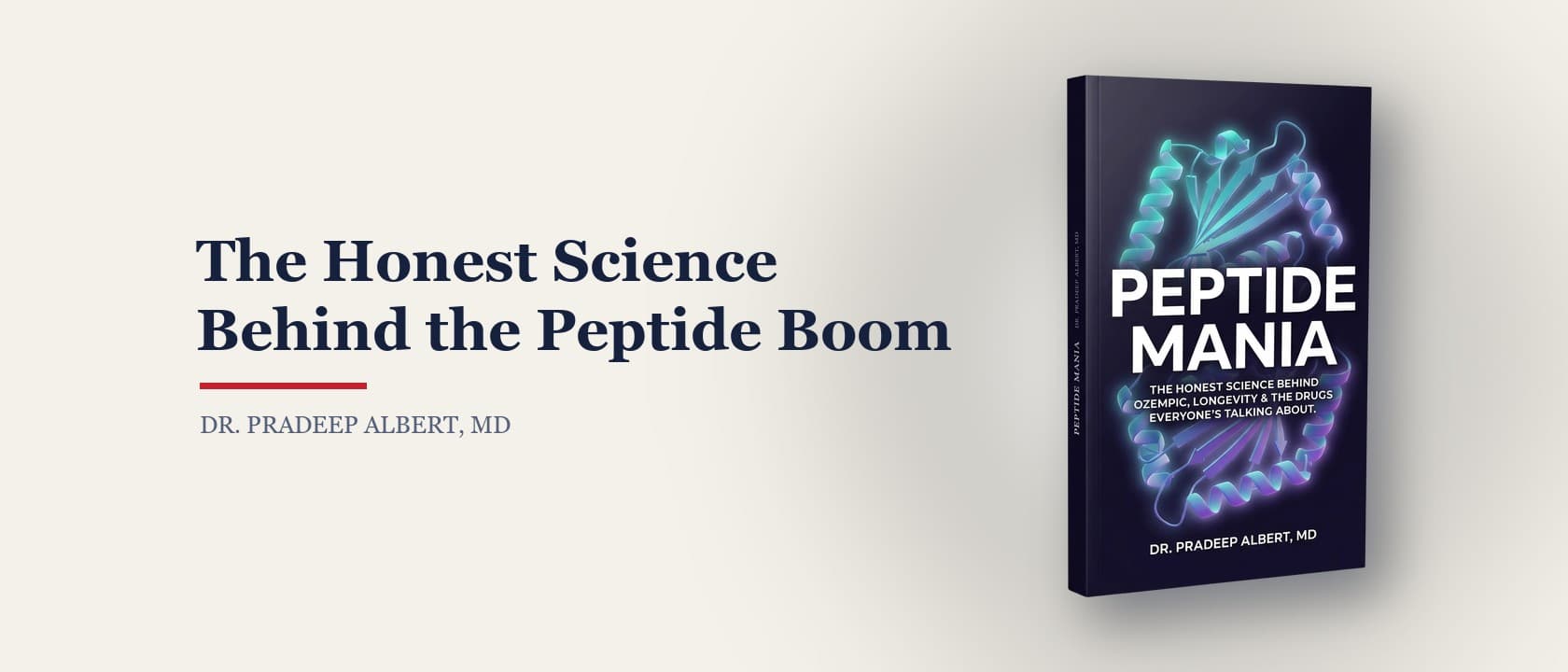
That gap is exactly why I wrote a book about it. Peptide Mania: The Honest Science Behind Ozempic, Longevity, and the Drugs Everyone's Talking About is the plain-English map I wish every patient had walking in. There is not a single dose in it. Just the science, told straight, so you can make sense of the mania for yourself.