


The Five Questions I Get Asked Most About Peptides

Audio Overview
Dr. Pradeep Albert, MD, Longevity Medicine Expert
Show transcript
I get asked about peptides in exam rooms. Also in hotel lobbies at conferences, by physicians deciding whether they should be treating with them. And across dinner tables, by people who heard something on a podcast and cannot tell science from advertisement. Since the advisory committee vote in late July, the volume has roughly tripled. The questions have not changed at all. It is the same five, in almost the same words. What actually is a peptide. Are they drugs. Why is the same compound legal in one form and not another. What would I want to know before starting anything. And the one everybody asks and almost nobody gets a straight answer to. They are natural, so they are safe, right? Here is the beginning of it. Your body already makes it is a true sentence, and it is not a safety argument. Safety belongs to a specific compound, from a specific source, at a specific dose, in a specific person. That last one is where nearly all the real work happens. I answer all five, plainly, in my new article.
I have been asked about peptides in a lot of settings. In exam rooms, obviously. But also in hotel lobbies at conferences by physicians who do not treat with them and want to know whether they should, and across dinner tables by people who heard something on a podcast and cannot tell whether it was science or an advertisement.
Since the FDA advisory committee vote in late July, the volume has roughly tripled. The questions have not changed at all. It is the same five, in almost the same words, and I have started to think that answering them plainly is more useful than anything else I could write this month.
So here they are, with the honest version of each answer. Including the third one, which is the question everybody asks and almost nobody gets a straight answer to.
1. What Actually Is a Peptide?
A peptide is a short chain of amino acids. That is the entire definition, and it is genuinely that simple.
Amino acids are the building blocks of proteins. String a few dozen together and you have a peptide. String more together and you have a protein. Your body manufactures thousands of different peptides every day, and they turn up in ordinary food like milk and eggs and meat, which is why nobody should find the word itself exotic.
What makes them interesting is what they do rather than what they are. Peptides are messengers. They carry instructions between cells: release this hormone, manage this blood sugar, signal fullness, start repairing that tissue. Because they speak the body's own signaling language, they can be extremely precise in a way that a broad-acting small molecule often is not.
The practical consequence is one I keep repeating. "Peptide" is a category roughly as broad as "pill." Insulin is a peptide hormone. So is the appetite signal that the weight-loss injections are modeled on. So is a compound with no human evidence behind it that somebody is selling on a website today. When a headline says peptides do something, ask which one, because the word by itself carries almost no information.
2. Are Peptides Drugs, or Something Else?
Mostly they are drugs, legally speaking, and this surprises people who have absorbed the idea that peptides occupy some third category between medicine and supplement. There is no such category.
American regulation actually draws a bright line here, and it is worth knowing because it explains a lot of otherwise confusing news. In a rule that took effect in March 2020, the FDA defined a protein as an amino acid polymer with a specific, defined sequence longer than 40 amino acids. Anything 40 amino acids or shorter is a peptide, and it continues to be regulated as a drug under the Food, Drug, and Cosmetic Act. Anything longer is a protein, which means it is a biological product licensed under a different statute.
Insulin is the clean illustration. To a biochemist it is a peptide hormone. It runs to 51 amino acids, so to a regulator it is now a biologic, and it formally transitioned to biologic licensure under that same rule. The molecule did not change. The legal door it walks through did.
The other door people ask about is the supplement aisle, and for most of these compounds it is closed. Federal law excludes from the dietary supplement definition an article that was first investigated as a drug. That is why you will not find a legitimate peptide in a supplement bottle, and why a company selling one as a supplement is usually telling you more about itself than about the compound.
Somewhere between eighty and a hundred and thirty peptide medicines have been approved in the United States, depending on where a given source draws the line on conjugates and on products that later became biologics. Either way, this is not a fringe class of medicine. It is a large, established one with a long clinical history and a noisy unregulated edge.
3. They Are Natural, So They Are Safe, Right?
This is the question I most want to answer carefully, because both of the usual answers are wrong.
The enthusiast's answer is "yes, your body already makes it." That statement is true and it is not a safety argument, and I say that as someone who works in this field and would rather it were otherwise. Your body makes these molecules in small amounts, at particular moments, in response to particular signals, under its own control. Introducing more of one from outside on a fixed schedule is an intervention. Interventions get judged one patient at a time.
Medicine has a very old lesson about this, and it happens to involve the most famous peptide of all. On January 11, 1922, a boy named Leonard Thompson received the first injection of insulin given to a person with diabetes. The first preparation was impure. It caused a reaction at the injection site and barely moved his blood sugar. It was refined, he was injected again twelve days later, and that time it worked, and he lived another thirteen years. Nothing about the hormone's natural origin protected him from that first dose. Purification did.
The skeptic's answer, meanwhile, is "peptides are unproven and dangerous," which fails for the reason the first question already covered. Peptides are not a thing that can be safe or dangerous, any more than pills can.
Safety is a property of a specific compound, from a specific source, at a specific dose, in a specific person. The first three get discussed constantly. The fourth almost never does, and in clinic it is where nearly all of the real work happens. What is your medical history. What else are you taking, because interactions are real and peptides are not exempt from them. Is there a personal or family history of certain cancers, which matters a great deal when a compound touches growth signaling and is a conversation rather than a checkbox. How well do your kidneys and liver clear things. And what are you actually trying to treat, because a therapy that is a reasonable trade against one problem can be a poor trade against another.
Two people can hold identical vials from the same accredited pharmacy and be in genuinely different positions. That is not a hedge. It is the answer.
4. Why Is the Same Compound Legal in One Form and Not Another?
Because legality attaches to the pathway, not to the molecule, and there are only a few pathways.
A compound can be an approved drug, which means a manufacturer took it through premarket review for a specific use. It can be prepared by a licensed pharmacy for an individual patient with a prescription, which is compounding, and which generally requires the raw ingredient to be on an approved list. Or it can be a dietary supplement, a door that is closed to most peptides for the reason above. What it cannot be is sold to you for injection by a website with a "research use only" or "not for human consumption" label. That phrasing is not a legal shield; it is a marketing one, and courts have not been impressed by it.
The clearest recent example of a molecule moving between doors is semaglutide. During the shortage, compounding pharmacies could prepare it under FDA enforcement discretion, and an entire telehealth industry grew up around that. When the agency declared the shortage resolved in early 2025, the discretion ended on published deadlines and that industry's legal basis went away. Same molecule, same patients, different status, because the supply conditions the exception rested on had changed.
Which brings up the news everyone is asking about. In July an FDA advisory committee recommended six peptides for the compounding list. A recommendation is not a rule. The agency still has to decide whether to act and then run formal rulemaking, and until a final rule exists nothing has changed for any pharmacy. If a vendor tells you a compound was just approved, they are describing a document that does not exist yet.
5. What Would You Want to Know Before Starting Anything?
Five things, in this order, and the order matters.
What am I actually treating, and is there something better established for it? This is first because it is the question people skip. A great deal of peptide interest is really interest in a symptom that has a boring, well-evidenced answer nobody wants to hear.
What does the human evidence show, as opposed to the animal evidence or the testimonial? A compelling mechanism and a striking rodent study are reasons to keep watching, not reasons to inject. Real science says "in this study, under these conditions, we observed." Marketing says "this changes everything."
Where does this come from, and is that source accountable for what is in the vial? A licensed pharmacy tests identity, purity, sterility, and endotoxin. An anonymous website tests nothing and answers to no one.
Who is supervising it? Dose, route, duration, and knowing what to monitor and when to stop are most of what separates a considered therapy from an experiment being run on yourself.
And what in my own history argues against this? If nobody has asked you that question, you have not had the conversation yet.
Where That Leaves You
None of this requires a science background. It requires being curious and a little skeptical at the same time, which is an uncomfortable posture to hold and the correct one for a field moving this quickly.
What I would resist is the pull toward either camp. The people telling you peptides are a miracle and the people telling you they are a scam are making the same mistake, which is treating a category as if it were a single thing. The useful questions are always narrower: which compound, from where, at what dose, for what problem, in whom.
This is general education rather than medical advice, and the conversation that actually matters is the one you have with a clinician who knows your history.
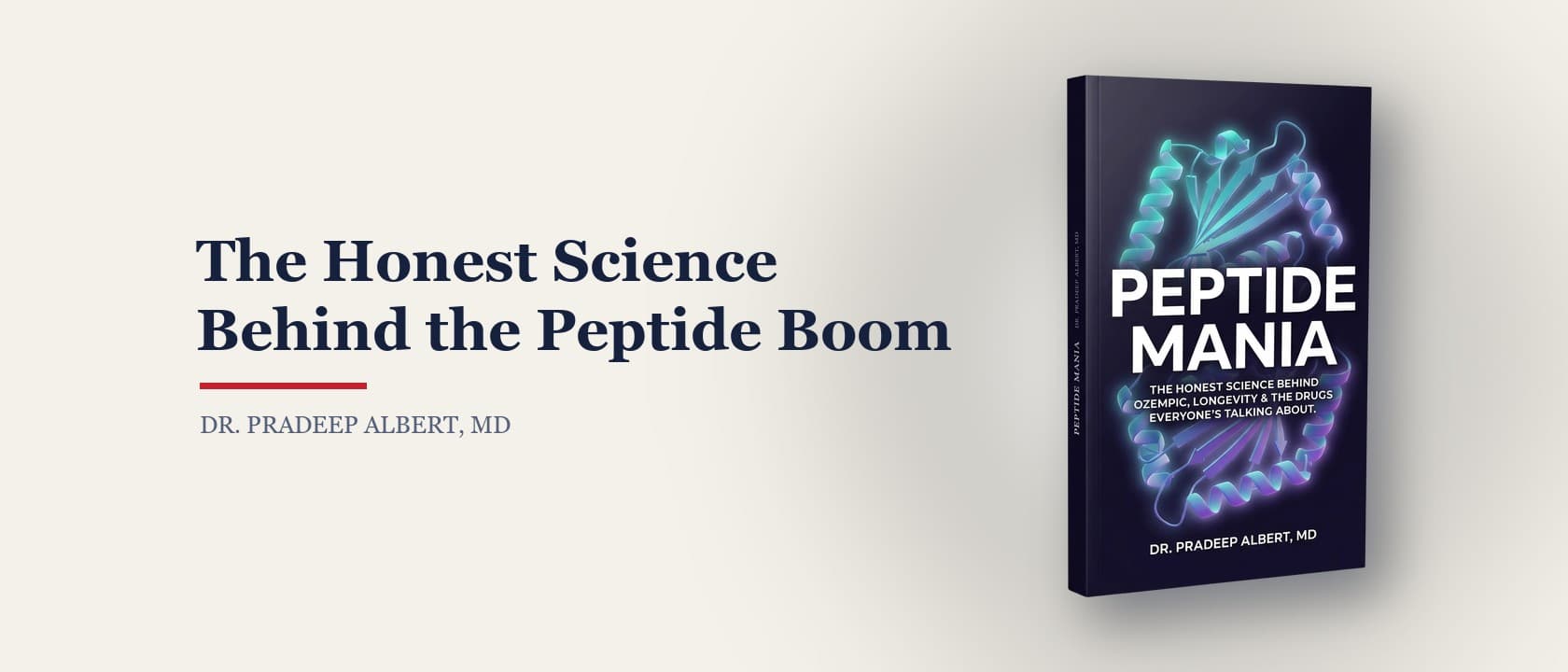
If you want the longer version, that is what I wrote Peptide Mania for. There is not a single dose in it. Just the science, told straight.